Arnold Snarb
The Crying of Lot 49Arnold Snarb is the Inamorati Anonymous participant Oedipa reaches by telephone near the end of her investigation. He is the man she had encountered earlier under the group’s rules of anonymity, and the only person she turns to when she fears that her discoveries may be a practical joke or an elaborate conspiracy. Their final conversation offers neither a verifiable answer nor reassurance: Snarb’s last words, “It’s too late,” leave their meaning unstated, while Oedipa is left alone with the possibility that Pierce is truly dead and that the mystery may have no human authority able to resolve it.
Identity and First Appearance
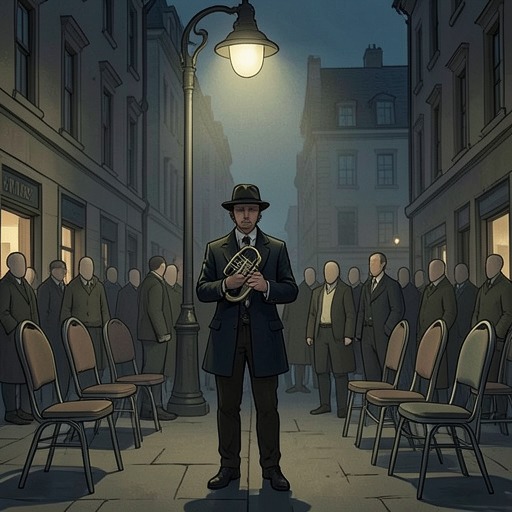
Snarb’s identity emerges through Inamorati Anonymous, a group whose members withhold their names and communicate under conditions that protect their anonymity. Oedipa first has reason to seek contact with its members after finding a latrine-wall notice directing people interested in a particular kind of social encounter to reach Kirby “through WASTE only.” The notice also bears an unfamiliar symbol. She copies the address and symbol into her memo book, unsure what either signifies. The message is an early instance of the marks and channels that will draw her toward the Tristero mystery, though it does not by itself establish a connection between the group and that network.
Later, at the office of Yoyodyne, Oedipa comes upon Stanley Koteks doodling a sign on an envelope. On a whim, she tells him, “Kirby sent me,” using the name from the wall notice. Koteks recognizes that she is lost, but this accidental encounter does not disclose who Kirby is or explain the message. Snarb is not identified in either episode. His name becomes known only much later, when Oedipa calls the group’s San Francisco meeting place and asks to speak with the anonymous member she had previously encountered.
The Late-Night Call
After discussing with Genghis Cohen the possibility that an unknown bidder at the auction may be associated with Tristero and trying to suppress evidence of its existence, Oedipa returns to Echo Courts and drinks bourbon until nightfall. She then drives on the freeway with her lights off. Shortly after midnight, she finds herself in a telephone booth in an unfamiliar, unlit district of San Narciso. From there she places a station call to The Greek Way in San Francisco, describes the acned, fuzz-headed Inamorato Anonymous she has spoken with before, and waits as the sounds of the bar come through the line.
When the man answers, Oedipa gives her name as Arnold Snarb. The brief exchange makes his identity explicit, but does not explain whether that is his actual name or one he uses within the group’s anonymous system. Snarb says he had been in the little boys’ room because the men’s room was full. Oedipa then speaks quickly, compressing what she has learned about Tristero and what has happened to Dr. Hilarius, Mucho, Metzger, Randolph Driblette, and Mike Fallopian into a single urgent report.
Oedipa tells Snarb that she does not know his name and does not want to know it, but needs to know whether the people around her arranged her encounter with him and his story about the post horn. She distinguishes the possibility of a joke from what the search has become for her: it no longer feels like a joke. She begs him to help, saying she has driven in a state of distress and fears that she may act more deliberately next time. The call thus turns the group’s anonymity from an abstract rule into a practical obstacle. Oedipa needs a dependable witness, yet insists she does not need the witness’s identity; what she wants is confirmation that the apparent pattern has not been staged for her.
Refusal and Ambiguous Ending
Snarb answers only with her name, then leaves a long stretch of bar noise on the line. Oedipa interprets his silence as an opening and says the others have saturated her, that from then on she will shut them out, and that he is free to tell her. He replies, “It’s too late.” When Oedipa asks, “For me?”, he answers, “For me.” He hangs up before she can ask what he means. Oedipa has no more coins; by the time she could find change, she assumes he would be gone.
The exchange does not establish that Snarb participated in a plot, that he knows who controls the clues, or that he can authenticate the post-horn story. His statement may concern his own circumstances, Oedipa’s situation, or something left deliberately unexplained; the scene supplies no clarification. His refusal, whether intentional or simply final, leaves the central question unresolved. The person Oedipa has chosen as her last available contact neither confirms her suspicions nor offers a counteraccount.
Narrative Role and Significance
Snarb’s importance lies in the gap between what Oedipa needs from him and what the conversation can prove. Across the investigation, separate objects, people, and routes begin to seem connected: a message invoking WASTE, the recurring symbol, postal carriers, and clues she associates with Tristero. At San Narciso she discovers that every access route she has followed can also be traced back to Pierce Inverarity’s estate. That convergence raises the possibility that the network is real, that it is a design by Pierce or his associates, or that Oedipa is reading intention into coincidences. Snarb’s call cannot distinguish among those possibilities.
After the call, Oedipa stands between the public telephone booth and her rented car, unable to orient herself toward either the sea or the mountains. The loss of bearings accompanies San Narciso’s loss of its apparent separateness: it becomes part of the larger American landscape rather than a bounded place whose clues can be contained. Oedipa’s recognition that Pierce is really dead does not resolve what he left behind. Snarb’s final words therefore function less as an answer than as a severed line at the moment she most wants one. The group’s promise of contact has delivered a voice, but not certainty, and Oedipa remains alone with the possibility that the legacy she is trying to interpret is larger than Pierce’s estate.